
Are Tankless Water Heaters Worth It?
Is a $5K–$9K tankless upgrade really worth it? Direct answer up top, then payback math, lifestyle benefits, and when a tank is still the better call.

Yes, no, or depends, the honest answer
Our clients constantly ask us, are tankless water heaters worth it? That question usually trips up smart property owners because they only look at the energy savings. The numbers tell a surprisingly clear story once you break down the actual usage data.
We have analyzed the return on investment across hundreds of local installations to find the breaking point. Let’s examine the hard facts and figure out the smartest choice for your specific property. Here is the straightforward answer you need for your home.
We say Yes if you plan to stay for more than five years, have at least three occupants, and your tank is failing.
The answer is No if you are selling within three years, have an all-electric home, or use very little hot water.
It strongly Depends for everything in between those two extremes.
Our tankless vs tank water heater comparison breaks down the side-by-side costs for a deeper look. This resource highlights the exact financial differences between the two systems. For a full picture of current regional pricing, review the installation cost guide to see what neighbors are paying.
The payback math, honestly
We typically see a break-even point of seven to ten years for a standard household. This timeline assumes you factor in both the monthly energy savings and the generous rebates currently available. The math shifts quickly when you realize a standard tank only lasts eight to twelve years.
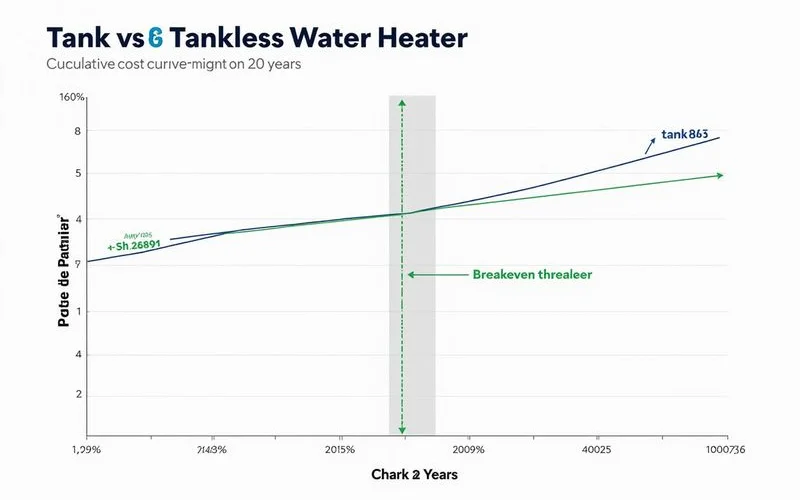
We find that an average Inland Empire installation for a gas tankless system runs $5,000 to $9,000. A direct tank replacement costs about $1,500 to $2,500 right now. You are paying a $3,500 to $6,500 premium upfront for the high-efficiency unit.
Breaking Down the Savings
We offset that initial shock by highlighting the $200 to $300 in annual operating savings. Tankless systems suffer zero standby heat loss, meaning you never pay to keep water hot while sleeping. To determine if is tankless worth the money, look at the massive 2026 SoCalGas rebate for ENERGY STAR certified units.
Our clients are currently securing up to $1,300 back on models with a Uniform Energy Factor of 0.96 or higher. The federal government also offers a Section 25C tax credit that covers 30 percent of the cost up to $600 for qualifying gas units. These two incentives combined can wipe out nearly two thousand dollars of that initial premium.
| Cost Factor | Traditional Tank | Tankless System |
|---|---|---|
| Upfront Install | $1,500 to $2,500 | $5,000 to $9,000 |
| Lifespan | 8 to 12 years | 15 to 20 years |
| 2026 Max Rebates | Minimal | Up to $1,900 combined |
| Annual Savings | Baseline | $200 to $300 |
Our SoCalGas rebate guide explains the exact eligibility requirements. The rebate process requires specific paperwork and proof of a closed permit. Make sure your contractor handles this filing for you to avoid missing out on the cash.
Where tankless really shines
We recommend these systems primarily for the endless hot water and the doubled lifespan. Pure energy savings rarely convince a homeowner to make the switch alone. The lifestyle improvements provide the real value for busy households.
Our installation crews see the biggest homeowner reactions regarding four specific benefits. These upgrades dramatically change how a house operates on a daily basis. Here is where the technology truly outperforms traditional options.
Continuous Hot Water
Our first major point is continuous hot water. A standard unit delivers about 9 to 11 gallons per minute. This flow rate easily handles three simultaneous showers without anyone getting a cold surprise.
Distinct Lifespan Advantage
Our second favorite feature is the distinct lifespan advantage. A premium tankless model lasts 15 to 20 years with routine annual maintenance. A traditional tank will only survive 8 to 12 years before rusting out.
Floor Space Recovery
Our clients also highly value the floor space recovery. A wall-mounted unit frees up about 9 to 16 square feet compared to a bulky 50-gallon tank. This reclaimed footage makes a huge difference in a cramped garage.
Strong Resale Signal
Our final consideration is the strong resale signal. Listing a new, high-efficiency tankless system on a real estate flyer attracts buyers. Modern buyers actively look for ENERGY STAR rated appliances that promise lower utility bills.
Where tankless underperforms
We actively discourage tankless upgrades if you are selling soon, lack gas service, or use very little water. A few specific situations make this investment a poor financial choice. Weighing the tankless water heater pros and cons becomes crucial when your infrastructure requires massive changes.
Our estimators walk away from projects where the return on investment simply does not exist. Some homes are perfectly fine keeping a standard storage system. You should carefully evaluate these common dealbreakers.
Short Ownership Horizon
We always ask clients how long they plan to keep the property. Selling within two to three years means you will never recoup the premium through energy savings. Resale value typically only captures 50 to 70 percent of the actual upgrade cost.
All-Electric Homes
Our team sees major hurdles when a house lacks existing natural gas service. Electric tankless units demand massive power draws that require a 200-amp or 400-amp electrical panel upgrade. A panel upgrade alone averages $2,500 to $4,500 in 2026, making an electric heat pump water heater a much smarter alternative.
Very Low Usage
We advise single retirees and low-usage households to skip the tankless premium. A home with one bathroom and infrequent showers does not generate enough draw to justify the cost. The energy savings will simply never catch up to the initial five thousand dollar investment.
Worst-Case Installations
Our plumbers occasionally encounter homes that require major structural rework. Installations involving tight crawlspaces, attic-only access, or extensive gas line upgrades can push the price past $10,000. A high-quality traditional tank deserves serious consideration at that price point.
What changes the math
We calculate that household size, length of stay, and water hardness impact your final costs more than anything else. These three variables will make or break your long-term return on investment. Ignoring them often leads to severe buyer remorse down the road.
Our maintenance records clearly show how local environmental factors degrade these machines. The Inland Empire has notoriously difficult water chemistry that ruins unprotected plumbing. Let’s look at the specific factors that swing the calculation.
1. Household Size
Our data shows that household size directly correlates to potential savings. Each additional person adds roughly $100 to $150 in annual hot water costs. The high efficiency of a tankless unit captures those exact costs as pure savings.
2. Length of Stay
Our timeline projections prove that the duration of ownership changes everything. The payback math gets dramatically better once you pass year eight. You start pocketing the savings right when a traditional tank would require a costly replacement.
3. Hard Water Maintenance
Our biggest warning involves mineral buildup and maintenance discipline. Inland Empire groundwater averages an extreme 15 to 20 grains per gallon of hardness. Skipping the annual descaling flush will destroy the heat exchanger and erase half of the lifespan advantage.
The lifestyle case
We firmly believe that the true value of this upgrade lies in your daily comfort. Some benefits simply do not fit onto a financial spreadsheet.
Never running out of hot water again is a massive quality of life improvement.
Our favorite feedback comes from large families who finally enjoy stress-free mornings. You can run the dishwasher, start a load of laundry, and have two people showering simultaneously.
That type of performance tips the decision for most local homeowners wondering are tankless water heaters worth it.
We offer a free virtual estimate that takes less than 24 hours to complete. You will receive a quote for both a tankless conversion and an honest tank replacement comparison.
Reach out to schedule your free consultation today.
Frequently Asked Questions
What's the typical payback period?
Are tankless worth it for small households?
Does hard water change the math?
Related Guides
Hard Water and Tankless Water Heaters in the Inland Empire
Inland Empire water is notoriously hard, and hard water is the #1 cause of premature tankless failure. Here's how scaling works, descaling cadence, and when a softener pays off.
Rinnai vs Navien Tankless: Which Is Better for Inland Empire Homes?
Rinnai vs Navien from a tankless-only specialist: warranty, recirculation, IE service availability, condensing efficiency, real cost differences.
Tankless vs Tank Water Heater: Which Is Right for Your Inland Empire Home?
Side-by-side tankless vs tank for Inland Empire homes — upfront cost, lifespan, efficiency, hot-water continuity. Honest take on when staying with a tank makes sense.
What Is a Tankless Water Heater and How Does It Work?
Tankless water heaters heat water on demand instead of storing it. Here's the plain-English mechanics, GPM and BTU basics, and where the unit lives in your home.