
What Is a Tankless Water Heater and How Does It Work?
Tankless water heaters heat water on demand instead of storing it. Here's the plain-English mechanics, GPM and BTU basics, and where the unit lives in your home.
We constantly see property owners struggling with rising utility bills and outdated water heating systems. That 40-gallon tank in the utility closet is likely wasting energy by keeping water hot around the clock.
Upgrading to an on demand water heater changes that equation entirely. If you are asking yourself how does a tankless water heater work, you are already on the right track to lowering your utility costs.
We will break down this technology, review the latest efficiency data, and explore practical installation requirements. This guide provides actionable advice to help you make the best decision for your property.
On-demand heating, no storage tank
A tankless water heater generates hot water instantly as it flows through the unit, eliminating the need to store heated water in advance. When a hot tap opens, cold water enters the system, passes over a heat exchanger, and reaches your fixture in seconds.
The entire process takes just 4 to 8 seconds from the moment you turn the handle.
Our team recommends these systems because they fundamentally change how a building consumes energy. The US Department of Energy reported in 2026 that tankless units are 24% to 34% more energy efficient than traditional storage tanks for households using 41 gallons or less daily.
Efficiency Takeaway: An average family of four can save about $95 to $124 annually on their utility bills simply by eliminating the constant reheat cycle of a storage tank.
We know that deciding to upgrade requires comparing your specific needs against the upfront costs. The next logical read for Inland Empire homes is our tankless vs tank water heater comparison. If you are already sold on the benefits, check out our tankless installation service for typical IE pricing.
Inside the heat exchanger
The heat exchanger functions as the core engine of a tankless system. It consists of a finned copper or stainless steel coil that rapidly transfers heat to cold water passing through it.
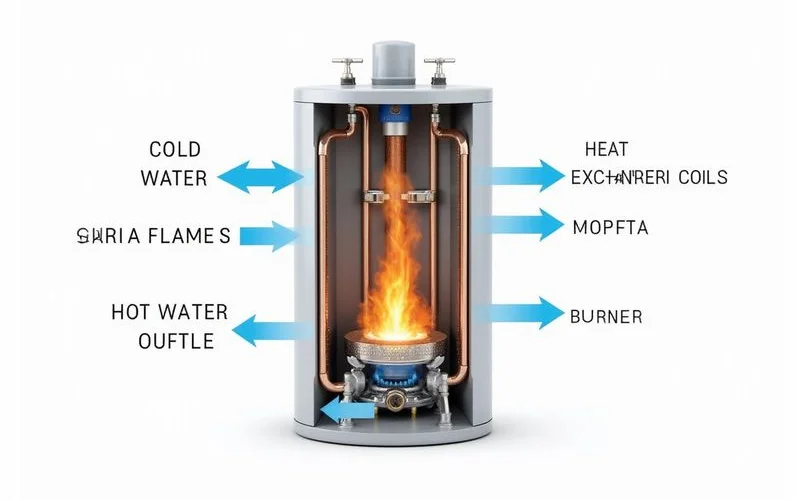
Our technicians usually explain that gas units rely on a high-BTU burner under the coil, while electric units use heavy-duty heating elements wrapped around it. Two critical numbers define how this component performs in your building:
- GPM (Gallons Per Minute): This measures how much hot water the unit delivers at a specific temperature rise. A standard US showerhead uses about 2.5 GPM, according to the Environmental Protection Agency. A mid-range unit delivers around 8 GPM, which easily handles a 70-degree Fahrenheit rise from 45-degree groundwater to a 115-degree shower.
- BTU Input: This figure indicates the gas energy required to reach that GPM rating. Residential gas models typically range from 140,000 to 199,000 BTUs. Higher BTUs allow you to push more gallons per minute during peak usage.
We always remind clients to check whether a system is condensing or non-condensing. Condensing models, like the Navien NPE series, use a secondary heat exchanger to capture exhaust heat.
This extra step boosts efficiency up to 98% and allows for cheaper PVC venting pipes. Non-condensing units require expensive stainless steel venting to handle 400-degree exhaust gases.
Gas vs electric tankless
Gas tankless models remain the default choice for most Inland Empire and US homes. Natural gas is widely available, and gas units deliver a lower cost per BTU than their electric counterparts.
Our installers note that electric models only make sense for small homes without gas service or for point-of-use applications at a single sink. The financial math for electric whole-home conversions rarely works out.
Electrical Cost Warning: Electric tankless heaters demand massive electrical upgrades. National data from 2026 shows that a standard 200-amp electrical panel upgrade averages $1,500 to $3,000, making the total installation significantly more expensive than gas.
We strongly encourage property owners to take advantage of local incentives for gas models. In 2026, SoCalGas offers massive rebates for upgrading to high-efficiency gas units.
High-Efficiency Gas Rebate Tiers
| UEF Rating | Example Brand/Series | 2026 SoCalGas Rebate |
|---|---|---|
| 0.82 to 0.86 | Standard High-Efficiency | Up to $80 |
| 0.87 to 0.94 | Noritz NRC Series | Up to $900 |
| 0.96 to 0.97 | Rinnai or Rheem Condensing | Up to $1,300 |
| 0.98 or Higher | Rinnai SENSEI RX, Noritz EZ | Up to $1,500 |
These financial incentives can easily bridge the price gap between standard tanks and premium tankless upgrades.
Where the unit lives in your home
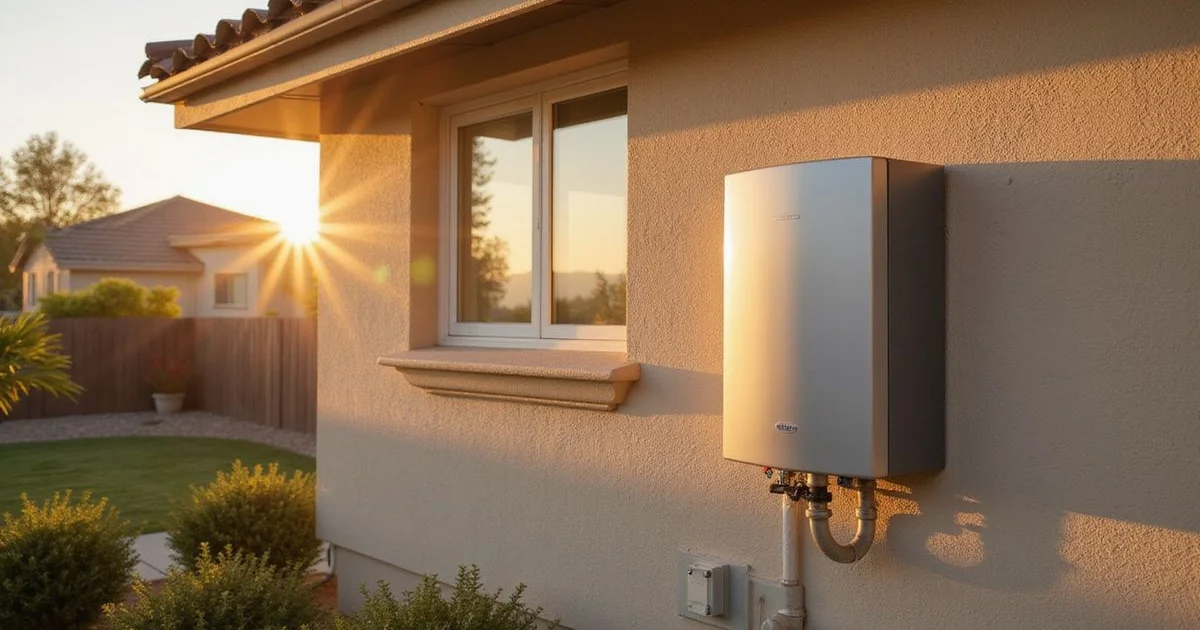
A tankless water heater mounts directly onto a wall and takes up about as much space as a standard briefcase. You instantly free up 4 to 6 square feet of floor space compared to a bulky 50-gallon tank.
Our crews find this space savings highly valuable for small utility rooms or cramped garages. You must follow strict US building codes and manufacturer clearances when selecting a mounting location.
The exhaust vent must terminate at least 12 inches away from any operable doors or windows to prevent carbon monoxide from entering the building. Here are the most common and effective installation spots:
- Exterior walls: This is the most common approach because it simplifies venting and gas line access. Units rated for outdoor exposure handle the weather perfectly.
- Garage interiors: This location keeps the unit clean and accessible. Venting simply runs straight through the closest exterior wall.
- Utility closets: Indoor setups work well if the vent pipe can run horizontally outside.
We actively avoid placing these units in crawlspaces or attics. Crawlspaces introduce severe freezing risks, while attics create complicated condensation drainage problems.
If you live in an area prone to freezing, ensure your outdoor unit features an internal ceramic freeze protection heater.
Why “instantaneous” or “on-demand”
The on-demand heating model eliminates the standby energy loss that plagues traditional water tanks. Older heaters constantly burn gas to keep stored water hot, even when you are asleep or at work.
Our data shows that standby loss accounts for a huge chunk of your monthly gas bill. A tankless unit only ignites when you actually open a hot water tap.
This precise operation drastically extends the expected lifespan of the equipment. The US Department of Energy confirmed in 2026 that tankless water heaters easily last 20 years or more, while standard tanks fail after just 10 to 15 years.
Maintenance for Maximum Lifespan
We warn every customer that hard water is the biggest threat to this long lifespan. Mineral scale builds up inside the narrow heat exchanger coils over time.
To keep a quality unit running for two decades, you must perform regular descaling. Property owners with severe hard water should flush their systems every 6 to 12 months.
You can easily do this yourself using a submersible pump and a few gallons of household white vinegar to dissolve the calcium deposits. Once you grasp the immense value of this instant heating model, choosing a specific brand or venting style becomes much easier.
Conclusion
Understanding exactly what is a tankless water heater gives you a clear advantage when planning home improvements. These systems provide superior energy savings, endless hot water, and a lifespan that doubles traditional tanks.
Our team is ready to help you size the perfect unit for your building. Check your local rebates, assess your electrical panel, and schedule a consultation with a licensed professional today.
Frequently Asked Questions
How is tankless different from a regular water heater?
How long does a tankless water heater last?
Will a tankless give me unlimited hot water?
Related Guides
Are Tankless Water Heaters Worth It? An Honest Take
Is a $5K–$9K tankless upgrade really worth it? Direct answer up top, then payback math, lifestyle benefits, and when a tank is still the better call.
Hard Water and Tankless Water Heaters in the Inland Empire
Inland Empire water is notoriously hard, and hard water is the #1 cause of premature tankless failure. Here's how scaling works, descaling cadence, and when a softener pays off.
Rinnai vs Navien Tankless: Which Is Better for Inland Empire Homes?
Rinnai vs Navien from a tankless-only specialist: warranty, recirculation, IE service availability, condensing efficiency, real cost differences.
Tankless vs Tank Water Heater: Which Is Right for Your Inland Empire Home?
Side-by-side tankless vs tank for Inland Empire homes — upfront cost, lifespan, efficiency, hot-water continuity. Honest take on when staying with a tank makes sense.