
Recirculation Pumps: Killing the Tankless Hot-Water Delay
Tired of waiting for hot water? Recirculation solves the tankless delay. NaviCirc vs Circ-Logic, dedicated loop vs crossover valve, and when to add it at install time.

As a professional service team, we constantly hear from property owners who upgrade their plumbing, only to find themselves standing at the sink waiting for warm water. This delay catches many people by surprise.
Our tankless installation service resolves this exact problem by integrating a tankless water heater recirculation pump right from the start. The EPA WaterSense data shows that waiting for warm water wastes over 11,000 gallons annually in an average US home. We know this issue is about both comfort and utility costs.
Let us look at the data, what it actually tells us, and explore a few practical ways to respond.
Why tankless feels slower than a tank for hot water delivery
Tankless systems feel slower because they require four to eight seconds to fire the burner, on top of the time it takes to push the resting cold water out of the pipes. We find that this added firing time makes the psychological wait feel much longer than the 30 seconds you might wait with a standard setup. A traditional storage heater holds 40 to 80 gallons of heated water ready to flow immediately.
Our field experience shows that modern low-flow fixtures make this delay even more noticeable. Federal and state regulations, like California Title 20, restrict shower flow rates to 1.8 gallons per minute.
We often see distant fixtures taking up to two full minutes to clear the cold water at that restricted speed. The system itself is highly efficient, but the plumbing layout simply requires more time to deliver the water.
How recirculation eliminates the delay
Recirculation eliminates the delay by keeping a loop of heated water continuously moving through your supply lines. We install these pumps so that hot water rests just a few feet away from every faucet in the building. Opening the tap brings the heat almost instantly, completely bypassing the cold water flush.
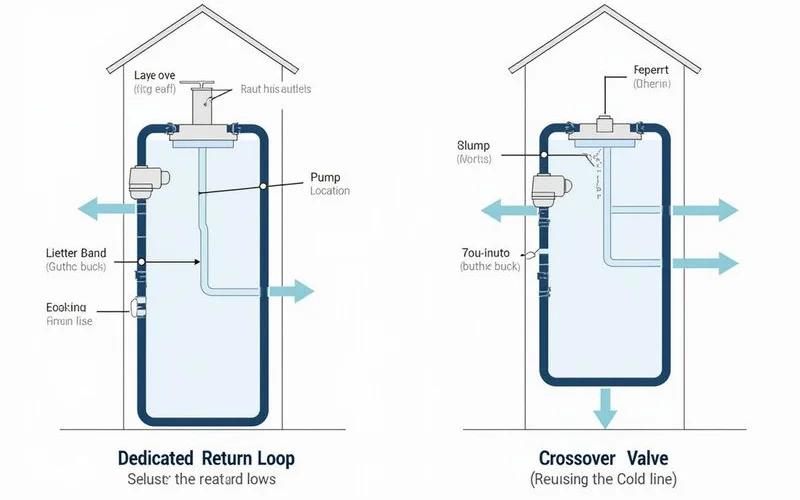
Our technicians rely on two main architectures to achieve this immediate delivery.
| Architecture Type | How It Operates | Best Application |
|---|---|---|
| Dedicated Return Loop | A third pipe runs from the furthest fixture back to the water heater. | Ideal for new US construction or extensive remodels. |
| Crossover Valve | A thermal valve connects the hot and cold lines under the sink, pushing cooled water back through the cold line. | Perfect for existing retrofits where adding pipes is too costly. |
These crossover valves, like the popular Watts thermal bypass valves, automatically shut off when the water hits 95 degrees Fahrenheit. We prefer this method because it prevents your cold water tap from getting too hot.
Most US homes built before 2010 lack a dedicated return line inside the walls. Our retrofit projects almost exclusively use the crossover valve approach to save thousands of dollars on drywall repair.
NaviCirc vs Rinnai Circ-Logic
Navien and Rinnai dominate the market, but their built-in delivery technologies take completely different paths. We often help clients choose between these two distinct approaches based on their existing plumbing layouts.
Navien NaviCirc Integration
The Navien NaviCirc system is fully integrated directly into their NPE-A2 and NPE-S2 condensing models. We appreciate that this all-in-one design requires no separate external pump installation. This specific internal pump utilizes a built-in ComfortFlow buffer tank and pushes water at roughly 0.53 to 1.06 gallons per minute.
Our installers find its smart-mode learning exceptional at recognizing daily usage patterns to optimize firing times. The upfront unit cost is slightly higher, but the streamlined installation makes up the difference.
Rinnai Circ-Logic Technology
Rinnai approaches this differently by using Circ-Logic firmware on their Sensei units to control an external pump. We typically install this external pump near the heater or tucked under the furthest fixture. The system pairs beautifully with the Control-R Wi-Fi module and the newly updated Rinnai Central App.
Our clients love using the smartphone application or Amazon Alexa voice commands to manually activate the pump on demand. This modular setup offers a lower base unit cost, though the separate pump installation adds minor labor charges.
You can review our complete Rinnai vs Navien comparison for a broader picture of these two industry leaders. We strongly recommend assessing your current pipe layout before choosing a brand.
When recirculation is worth it
Recirculation is worth the investment if your distant bathrooms take more than 30 seconds to heat up or if your household experiences frequent simultaneous morning showers. We evaluate every floor plan to see if the upfront hardware costs justify the daily convenience.
These specific scenarios offer a strong case for upgrading your system:
- Large US Floor Plans: Sprawling suburban homes often have long supply runs. We frequently see master bathrooms taking 60 to 90 seconds to clear the cold water without a pump.
- High-Traffic Bathrooms: Busy mornings demand efficiency when multiple people need showers. Our team installs these systems to guarantee instant heat at every tap, eliminating the staggered waiting game.
- Concurrent Installation: Adding the pump during the initial water heater setup keeps the marginal cost extremely low. We save you the expense of a separate service call later.
- Tank-to-Tankless Transitions: Moving from an older storage tank introduces an unfamiliar 8-second burner delay. Our clients often find this minor wait psychologically frustrating after years of instant delivery.
Conversely, you might skip the upgrade in these weaker cases:
- Compact Layouts: Small, single-story homes with plumbing clustered near the garage have very short supply runs. We consider the delay in these compact setups to be completely negligible.
- Strict Budgets: Skipping the $500 to $900 pump accessory frees up capital for a higher-capacity heater. Our technicians can help you allocate that money to a unit with a higher flow rate instead.
- Sporadic Usage: Vacation homes simply do not generate enough daily data for smart-mode learning to function properly. We suggest skipping the pump if the property sits empty for weeks at a time.
Smart-mode efficiency
Modern smart-mode recirculation limits energy waste by learning your schedule and pre-heating the lines only during your typical usage windows. We install these intelligent systems to replace the older, always-on loops that constantly drained electricity and gas.
California Title 24 energy codes now strictly regulate recirculation systems to prevent continuous, unmonitored pumping.
Our technicians utilize demand-based controls to comply with these rigorous US energy standards. The older continuous 25-watt pumps could cost a household roughly $26 to $34 annually in electricity alone, plus massive natural gas waste.
We find that today’s smart-mode operation typically drops that total monthly energy cost down to just $5 to $15. The pump simply sleeps outside of those predicted high-demand windows.
Adding a tankless water heater recirculation pump at install vs retrofit
Adding a tankless water heater recirculation pump during your initial water heater setup is always the most cost-effective choice. We strongly advise rolling the pump into the primary project to avoid paying for a second labor visit.
National US averages in 2026 show that standard plumber labor rates range from $150 to $250 per hour. Our initial installation quotes bundle the labor, meaning you only pay the $400 to $900 added cost for the materials and minor setup time.
Choosing to retrofit the system months later requires a separate truck roll and fresh diagnostic time. We typically see retrofit totals jump to $700 or even $1,400 depending on the plumbing modifications required. Our tankless installation process guide shows exactly which day this hardware gets added during a full install.
| Timing | Estimated Total Cost | Labor Impact |
|---|---|---|
| At Install Time | $400 to $900 | Bundled labor, single visit, highly efficient setup. |
| As a Retrofit | $700 to $1,400 | Separate truck roll, requires new diagnostics and pipe adjustments. |
If you are debating the accessory, the financial math heavily favors doing it immediately. We cover these exact figures during your initial virtual estimate so you can make a fully informed decision.
Conclusion
Upgrading your plumbing should permanently solve your water delays, not create new frustrations. We know that choosing the right tankless instant hot water components can feel overwhelming at first.
The data clearly shows that a well-designed tankless water heater recirculation pump saves thousands of gallons of water and provides immediate daily comfort. Our experts are ready to review your floor plan and find the perfect recirculation solution for your home.
Contact our support staff today to schedule an evaluation and finally get the instant performance you deserve.
Frequently Asked Questions
Does recirculation waste energy?
Can I retrofit recirculation later?
Do I need a dedicated return line?
Related Guides
SoCalGas Tankless Water Heater Rebates Explained
SoCalGas tankless rebates typically run $600–$1,000. Here's eligibility, application steps, what we handle vs what you submit, and other CA utility programs.
Financing Options for Tankless Water Heater Installation
Financing turns a $5K–$9K tankless install into a manageable monthly payment. Common 0% promo plans, fixed-rate terms, and how to apply through our partner network.
Gas Line and Venting Requirements for Tankless Water Heater Installation
Why tankless needs more gas than a tank, when a gas-line upgrade is required ($350–$2,000), and the difference between PVC and concentric stainless venting.
Is My Home a Good Candidate for Tankless Water Heater Installation?
Find out if your Inland Empire home is right for tankless. Check fuel source, gas capacity, wall access, venting path, and household demand before requesting an estimate.