
Upgrading to Higher GPM: Sizing Tankless for a Growing Home
Outgrew your tankless? Here's how GPM ratings work, simultaneous-use math, gas-line implications when going larger, and recirculation upgrades to consider.
Our team frequently sees homes outgrow their hot water capacity after a few short years. Family sizes increase, new bathrooms get built, and 2026 data shows accessory dwelling unit permits are surging across the US. Suddenly, that reliable 8 GPM unit cannot keep up with two morning showers and a running dishwasher.
We know exactly how frustrating cold mid-shower surprises can be. This guide will break down the data behind flow rates and show you how to calculate your true peak demand.
If you are considering upgrading higher GPM tankless capacity today, our tankless replacement service handles the unit sizing as part of the swap. Not certain whether your existing unit is genuinely undersized or simply nearing end of life? Our when to replace your tankless guide helps you tell the difference before you commit to a bigger system.
When your tankless feels too small
A water heater perfectly sized at installation often becomes undersized over time. A home remodel or a new high-flow soaker tub drastically changes your daily water demand. Recent reports from Cotality show that ADU construction permits increased by 40 percent in high-demand US markets between 2024 and 2025.
Our technicians notice that adding just one of these secondary living spaces easily pushes a standard tankless system past its limit. The symptom is always the same. You get a blast of cold water in the middle of a shower because the unit cannot heat the water fast enough.
Upgrading higher GPM tankless systems solves this problem by matching your new household demand. A larger unit provides the necessary buffer so multiple people can use hot water simultaneously without interruption.
Common Causes of Undersized Systems
- New Additions: Adding an ADU or a guest house to the property.
- Bathroom Remodels: Upgrading to multi-head luxury showers.
- Growing Families: More people taking showers at the exact same time.
How GPM ratings work
Gallons per minute ratings determine the exact flow rate your unit can deliver at your home’s specific temperature rise. You must look at the manufacturer specifications for your local climate to find the true output.
Our team wants you to understand how groundwater temperatures dictate performance. In the Inland Empire, groundwater enters the home at roughly 45 degrees Fahrenheit. Most homeowners set their output temperature to 115 or 120 degrees.
That creates a 70 degree temperature rise. Different brands publish GPM ratings based on entirely different temperature rises. You need to read the fine print carefully.
- At a 35 degree rise: A unit marketed in Florida might show a massive 11 GPM capacity.
- At a 70 degree rise: That exact same unit will only deliver about 5.5 GPM in the Inland Empire.
We always normalize these numbers to local conditions when comparing units. For example, a 199,000 BTU flagship model like the Navien NPE-240A2 tops out at exactly 5.6 GPM under a 70 degree rise. The Rinnai RU199iN delivers a nearly identical 5.5 GPM at that same temperature difference. You must focus on the 70 degree specification to find your real number.
Simultaneous-use math
Mastering tankless GPM sizing comes entirely from your peak simultaneous demand, not your average daily use. You must calculate the highest number of fixtures running at the exact same time to find your target flow rate.
Our experts use the latest plumbing standards to calculate this peak load accurately. The Environmental Protection Agency updated their WaterSense program for 2026, pushing for stricter 2.0 GPM limits on new showerheads. Keep in mind that older homes still feature high-flow fixtures.
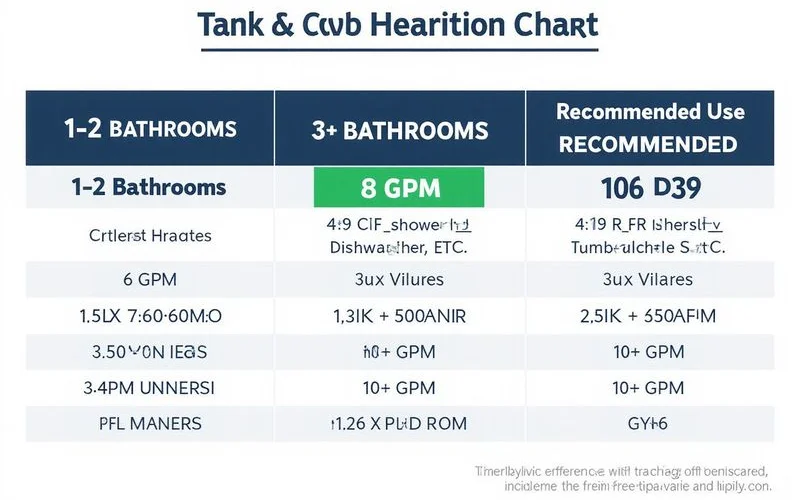
| Fixture | Typical GPM Draw |
|---|---|
| Standard shower | 2.0 to 2.5 |
| Low-flow shower (2026 EPA standard) | 1.8 to 2.0 |
| Bathtub fill | 4.0 to 6.0 |
| Kitchen sink | 1.5 to 2.0 |
| Bathroom sink | 1.0 to 1.5 |
| Dishwasher | 1.0 to 1.5 |
| Clothes washer (hot fill) | 1.5 to 2.5 |
We recommend calculating your absolute worst case morning routine. Finding your highest usage point ensures you never run out of hot water.
Real-World Sizing Scenarios
- Scenario A (One person, basic morning): One shower (2.5) plus a bathroom sink (1.0) equals 3.5 GPM. A 6 GPM unit handles this with plenty of margin.
- Scenario B (Couple, morning conflict): Two showers (2.5 plus 2.5) plus a kitchen sink (1.5) equals 6.5 GPM. This requires a 7 GPM unit or better.
- Scenario C (Family of four, big day): Two showers (2.5 plus 2.5) plus a dishwasher (1.5) and a clothes washer (2.0) equals 8.5 GPM. This home needs a 9 to 10 GPM system.
- Scenario D (4+ bathrooms, weekend rush): Three showers (7.5) plus a dishwasher and washer equals 11+ GPM. This requires an 11 GPM condensing flagship or even a dual-unit setup.
If your current unit is undersized for your worst case, you will experience cold water mid-shower.
When upgrading triggers a gas line resize
A higher GPM output requires a higher BTU capacity, which subsequently increases your gas demand. Sometimes the existing gas piping in your home cannot deliver that required volume safely.
Our technicians follow the National Fuel Gas Code (NFPA 54) to ensure your system operates safely. Upgrading from a standard 160K BTU unit to a 199K BTU flagship model often triggers a gas line resize. This is especially true for homes built with standard half-inch gas lines.
You can sometimes avoid a complete line replacement under specific NFPA 54 conditions. A half-inch gas line can support a 199,000 BTU unit if the pipe run is under 40 feet and the static gas pressure is at least 8 inches of water column.
Common Upgrade Pathways
- 180K BTU non-condensing to 180K BTU condensing: This is usually fine on the existing line.
- 160K BTU non-condensing to 199K BTU condensing: This frequently triggers a line resize on half-inch piping systems.
- 140K BTU older unit to 199K BTU current flagship: This almost always requires a complete pipe resize.
We know that a gas line upgrade adds between $350 and $2,000 to the total replacement cost. See our gas line and venting requirements guide for the specific details. A virtual estimate allows us to confirm these requirements before work begins.
Right-sizing without overspending
A common upgrade mistake is jumping straight to the largest unit available simply to feel safe. Sizing your system accurately protects your budget while ensuring comfort.
Our pricing analysis shows that the unit cost difference between an 8 GPM model and an 11 GPM model is quite meaningful. Upgrading from a Navien NPE-180A2 to the flagship NPE-240A2 adds roughly $400 to $500 in retail costs alone. A major gas line upgrade might not be worth the investment if you never actually need that maximum capacity.
The best approach is to size to your real peak demand and add a 1 to 2 GPM cushion for future growth. If your worst case is 7 GPM today, installing a 9 GPM unit makes perfect sense. This leaves plenty of room for a child growing old enough for full-length showers without overbuilding the system.
Cost Factors to Consider
- Retail Unit Price: Larger heat exchangers cost more to manufacture.
- Gas Line Modifications: Labor and materials for new 3/4 inch iron piping.
- Venting Upgrades: Larger units may require updated PVC or concentric venting.
Adding recirculation during the upgrade
If you are already replacing the unit, this is the most cost effective time to add a recirculation system. When selecting a tankless for big house applications, built-in systems like Navien NaviCirc or Rinnai Circ-Logic eliminate the frustrating wait time for hot water at distant fixtures.
Our team highly recommends bundling this feature for larger homes with long supply runs. A recirculation system uses a pump and a crossover valve to loop hot water through your existing plumbing. The Environmental Protection Agency estimates that an average family can save up to 2,900 gallons of water per year by eliminating the daily drain wait.
Upfront Versus Retrofit Costs
| Installation Timing | Estimated Extra Cost |
|---|---|
| Adding at replacement time | $400 to $900 |
| Retrofitting later | $700 to $1,400 |
We bundle recirculation on almost every large home upgrade because the math just makes sense. You save money on labor, and the comfort upgrade is immediate. See our recirculation pump guide for a detailed comparison of the different pump options.
The replacement timeline
Most GPM upgrade replacements complete in 4 to 6 hours on a single installation day. You will lose water access during this window, but the system always comes back online before dinner.
Our installation process strictly follows the updated 2026 California Plumbing Code requirements. Every replacement requires a permit and must pass a final safety inspection. Inspectors will specifically check for two approved seismic straps, a properly routed temperature and pressure relief valve, and an approved drain pan.
The Standard Installation Day
- Removal: Disconnecting and recycling the old unit.
- Modifications: Resizing the gas line if required (adds 1 to 2 hours).
- Mounting: Installing the new higher-GPM unit with compliant seismic strapping.
- Enhancements: Adding a recirculation pump and crossover valve if specified.
- Testing: Commissioning the unit, testing water flow, and completing a homeowner walkthrough.
We actively coordinate the inspection timing with your local city building department. Most homeowners schedule the installation for a Tuesday or Wednesday so any municipal inspection follow-up clears within that exact same week.
The virtual estimate is always your first step. Send us photos and tell us about your household peak demand. You will receive an honest unit sizing and a total price quote that includes any required gas line work.
Upgrading higher GPM tankless units is a smart investment in your daily comfort and your property value. Matching your equipment to your actual water usage eliminates the morning rush frustration once and for all.
We make the sizing process simple and transparent. Reach out to us today with photos of your current setup, and let’s get your virtual estimate started.