
How Often Should You Service a Tankless Water Heater?
Annual minimum, every 6 months in the hardest Inland Empire water zones. How a water softener changes the cadence and what most brand warranties require.
Property owners frequently ask us how often service tankless water heater units need to stay efficient. The standard advice online often misses the reality of our region’s specific water quality.
Our team regularly sees units fail years before their time simply because they were on the wrong tankless maintenance schedule.
Let’s look at the hard data, what it actually means for your plumbing, and how to keep the hot water flowing.
The short answer for Inland Empire homes
Annual minimum across most of the Inland Empire is the baseline, while every six months is necessary in the hardest water zones. This is the reliable working answer for Riverside and San Bernardino counties.
If you skip annual descaling in our region’s hard water (10 to 20 grains per gallon), you will watch your unit lose performance quickly. Dissolved calcium and magnesium build up inside the narrow pathways of the heat exchanger, forcing the system to work harder and risking severe damage within four to five years.
Our tankless maintenance service handles this heavy lifting in a single 60 to 90 minute visit. The process involves circulating professional-grade descalers like Hercules Haymaker with a 1/3 HP submersible pump for a full 45 minutes to dissolve stubborn deposits. We also clean the inlet water filters and complete the necessary warranty documentation.
Cadence by water hardness zone
Different zones in the Inland Empire have meaningfully different water hardness levels. The primary culprits are calcium and magnesium, which arrive through local groundwater and the Colorado River aqueduct. Your exact tankless service interval depends heavily on these local measurements.
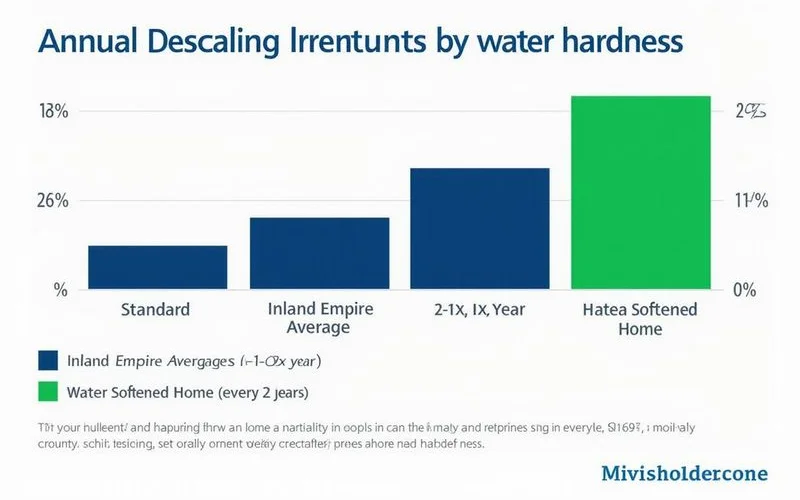
| Zone | Typical hardness | Recommended cadence |
|---|---|---|
| Corona, Murrieta, Ontario, Rancho Cucamonga | 8 to 12 GPG | Annual |
| Moreno Valley, Fontana, Redlands | 10 to 14 GPG | Annual |
| Riverside city center, Temecula | 14 to 18 GPG | Every 8 to 10 months |
| Hesperia, Victorville, San Jacinto | 16 to 22 GPG | Every 6 months |
These are reliable guidelines, but your specific neighborhood may test higher or lower than the zone average. Local water districts, such as EMWD, Western MWD, and Indio Water Authority, publish annual Consumer Confidence Reports detailing this precise data.
We recommend searching for your address in these reports to find your exact grains per gallon (GPG) rating. Finding this number takes five minutes and gives you a clear, factual target for maintenance.
How a water softener changes the cadence
A properly maintained whole-home water softener removes calcium and magnesium before the water reaches the tankless unit. This drastically alters your tankless maintenance schedule. With softened water, you can safely extend the time between flushes:
- In a normal-hardness IE zone (Corona, Murrieta, Ontario, Rancho Cucamonga): Stretch to every 18 months safely.
- In a hard-water IE zone (Riverside city center, Temecula): Stretch to annual instead of every 8 to 10 months.
- In the hardest zones (Hesperia, Victorville, San Jacinto): Stretch to every 10 months instead of every 6.
The catch is that the term “properly maintained” really matters. Softeners need monthly salt level checks and regular regeneration cycles to function effectively without experiencing salt bridging.
We confirm the softener is actively working during the maintenance visit if you have one installed. The small inlet water filters on the tankless unit still catch debris, so they require cleaning regardless of water softness.
What manufacturer warranties require
Most flagship tankless warranties require documented annual service to maintain heat exchanger coverage past year three or five. The specific requirements are quite strict across the major brands:
- Rinnai Sensei (15-year exchanger): Annual service is required, and it must be documented by a licensed installer.
- Navien NPE-A2 (15-year exchanger): Annual service is required to protect its dual stainless steel heat exchangers.
- Rheem Performance Platinum (12-year exchanger): Annual service is strongly recommended, though specific terms vary by model year.
- AO Smith and Bradford White: Annual service is strictly required for most warranty tiers.
A homeowner with no service record fighting a year-12 heat exchanger failure has a very difficult warranty conversation compared to one with documented annual descaling. Unmaintained units often develop pinhole leaks in the heat exchanger because the acidic scale eats away at the metal.
We always remind customers that the $200 to $400 annual maintenance cost is basically $200 to $400 of warranty insurance. An out-of-pocket heat exchanger replacement can easily exceed $1,500 if the warranty claim is denied.
Signs you’ve waited too long
If you have gone 18 months or more without service in the Inland Empire, your system will start showing signs of strain. Watch for these clear indicators that scale has compromised the internal pathways:
- Lukewarm or unstable water temperature.
- Longer wait to get hot water at distant fixtures.
- Error codes appearing on the display, such as a Rinnai “LC” scale code or a Navien “E016” code.
- Dropped GPM, which feels like a weaker shower flow.
- Higher gas bills with the exact same usage.
- Kettling noises, which sound like popping or rumbling coming from inside the unit.
When two or more of these symptoms show up, the next descaling is completely overdue and will likely require a deep flush. This deep flush extends the circulation time to 90 minutes instead of the standard 45 minutes and uses a much higher concentration of descaler to recover what is still recoverable. Our tankless descaling and flushing guide walks through the exact pump-and-bucket process step by step.
We typically recommend a full inspection of the heat exchanger condition if you have gone three or more years with no maintenance. Descaling alone will not restore full performance in severe cases, making an expensive replacement your only remaining option.
Annual service plans vs paying per visit
We offer annual maintenance plans across the Inland Empire to make this upkeep entirely automatic. The benefits of a structured plan include:
- Scheduled visits: The office tracks your timeline and books the appointment.
- Priority emergency dispatch: Plan members jump to the front of the line if a component fails.
- Direct cost savings: Members receive a 10 to 15 percent discount over booking one-time service calls.
- Documented service records: The paperwork required to protect your 15-year warranty is automatically maintained.
- Ultimate convenience: Make one annual decision instead of trying to remember to call us.
Plans run $150 to $300 per year, depending on the required cadence and specific add-ons like water softener servicing. This is a fraction of the heavy replacement cost for a ruined heat exchanger.
Our most common scenario involves a homeowner starting on an annual plan, then shifting to a six-month cadence. The evidence found during their first deep flush usually proves exactly how much mineral scaling accumulates in their specific neighborhood.
Bottom line
If you take nothing else from this guide, keep the baseline rule in mind. An annual minimum is required, and every six months is mandatory in the hardest zones.
Knowing exactly how often service tankless water heater units require in your area is half the battle. Acting on that information is what actually protects your investment.
We see the math play out every week, and regular descaling always wins against early replacement. Softened water lets you stretch the timeline just a bit, but skipping the cadence entirely is a major financial risk.
Check your local water quality report today, then call our team to get your next maintenance visit on the schedule.